Consider the options that work best for your community
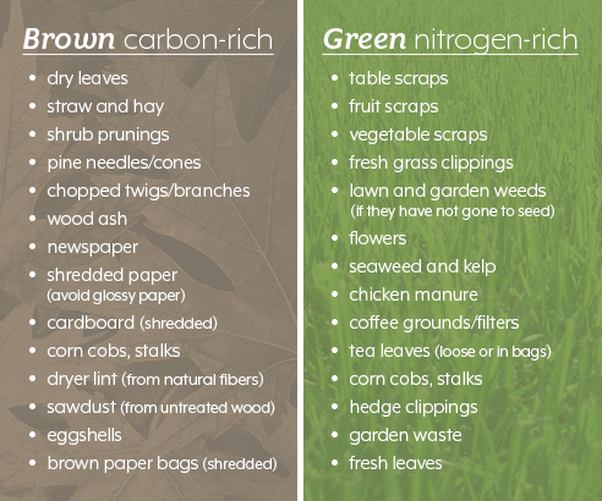
You can make compost using a mixture of different waste streams, often referred to as green (nitrogen-rich) and brown (carbon-rich) materials.
- Garden waste (including some brown wastes)
- Food waste – kitchen and canteen waste (with and without animal by-products)
- Other brown waste (shredded paper, card, etc)
If the mix is off, the compost will not heat up enough and microbes will not activate and begin breaking down the material. Aim for a ratio of 3 or 4 brown to 1 green, but don’t worry about being too precise.
If you are a household you can compost any of the above wastes in your own garden. If you have an allotment on land owned by the council or other, you need to check the rules that are in place. If you are a community project there are regulatory requirements you need to follow which are set out in the Quick Guide to Regulations and Guidance for different waste streams.
Garden waste
Garden waste can be any cuttings from individual household gardens or from other public and private areas, such as roadside verges, parks and estates. If coming from public or private areas your community will need permission from the landowners to use these. You should also be careful to not include invasive weeds (such as: Japanese knotweed, giant hogweed, Himalayan balsam, rhododendron ponticum and New Zealand pygmyweed). Garden waste is the simplest ingredient for making compost, and it is important to include a mixture of green and brown waste as explained below:
- Green waste – consists of grass, straw, hay, leaves, trimmings from perennials and annuals, as well as annual weeds that haven’t set seed.
- Brown waste – means tree and shrub prunings (finely chopped), as well as shredded paper/card (see more on this below – “other brown waste”).
Food waste
Food waste with animal by-products (ABPs) refers to meat, eggs, egg shells, fish, shell fish or oil used for cooking these. ABPs are a potential source of risk to human and animal health and as such require specific, additional considerations. You can find further guidance on what is considered an ABP here.
Food waste without animal by-products refers to vegetable and/or fruit waste ONLY, which includes peelings, left-overs, or fruit and vegetables no longer suitable for consumption.
If you only collect fruit and vegetable waste for composting and do not take food waste containing meat or other animal by-products then your project will not need to be regulated by the Animal & Plant Health Agency (APHA). If you do want to take such waste then you need to go through a checklist to understand if your project does need APHA approval and ongoing monitoring. See the Quick Guide to Regulations and Guidance for more information.
One reason for avoiding animal by-products such as meat is that it is likely to attract vermin to your site (if not correctly planned for), and might also add to the cost of your project. The cost implication depends on how much food waste (containing APBs) you collect, where it is stored and where the compost you produce will be used. These factors significantly influence the score you achieve when you go through the APHA checklist above.
Food waste consisting of only vegetable and fruit waste is therefore much less onerous to collect and compost, which is why many sites start this way and later progress to include animal by-products. However, it must be composted in a closed container i.e. you cannot do this in an open pile. In terms of closed containers you can build your own box or boxes, or buy composters from a range of organisations. More information is provided on these in the Technology & Method section of this guide. If you decide to compost food waste with animal by-products this must also be in an enclosed container.
Click here for a detailed study by Propagate commissioned by Glasgow Community Food Network on composting methods and models. Small-scale projects (even those including the composting of meat) are most likely to have little or no costs for complying with regulations. It is important, therefore, that the design of your project considers the regulatory requirements, which are described in more detail if you go to the Quick Guide to Regulations and Guidance page.
Other brown waste
You can use shredded paper and card, as well as wood shavings/sawdust (no chemicals added) for composting, e.g. as a substitute for tree and shrub prunings etc mentioned above.
If possible you should consider if it might be best to put these paper/card into local recycling bins for collection. If your site needs this material you should be careful to manage it to avoid staples and tape getting into the mix.
If shredded paper/card is used in an open pile with garden waste it could make up a significant part of the mix, or if used with a container/bin it can be much higher. Most of the time, it is recommended that you use untreated paper for your compost. If the paper is covered with heavy or potentially-toxic inks, for example from a printer, or it is coloured paper, it should not be composted and put to a recycling container instead.
Mixed garden/brown and food waste
It should be noted that if you mix food waste with garden/brown waste the regulations applied to food waste apply to the whole compost pile.