
Climate Hub Article Spring 2026
Written by Lusi Alderslowe
Across Dumfries and Galloway, local communities are taking climate action into their own hands – by turning food waste into soil.
Propagate are working with communities in Moniaive, Gatehouse of Fleet and Whithorn to co-design and establish three pilot community composting sites. The aim is simple: to transform local food waste into a valuable resource, while reducing greenhouse gas emissions and building community resilience.
When food waste goes to landfill, it decomposes without oxygen, producing methane – a greenhouse gas around 30 times more potent than carbon dioxide. Community composting offers a practical, local solution.
Funders and Support
We are very grateful to the Dumfries and Galloway Climate Hub and the Dumfries and Galloway Community Led Local Development Fund (CLLD) for supporting this innovative pilot.
The Three Pilot Sites
Each community is shaping the project in its own way. Each site will include:
- A Jora composter
- A locally designed Dumfries & Galloway composter
- Woodchip storage
- A maturation bay for finishing off the compost
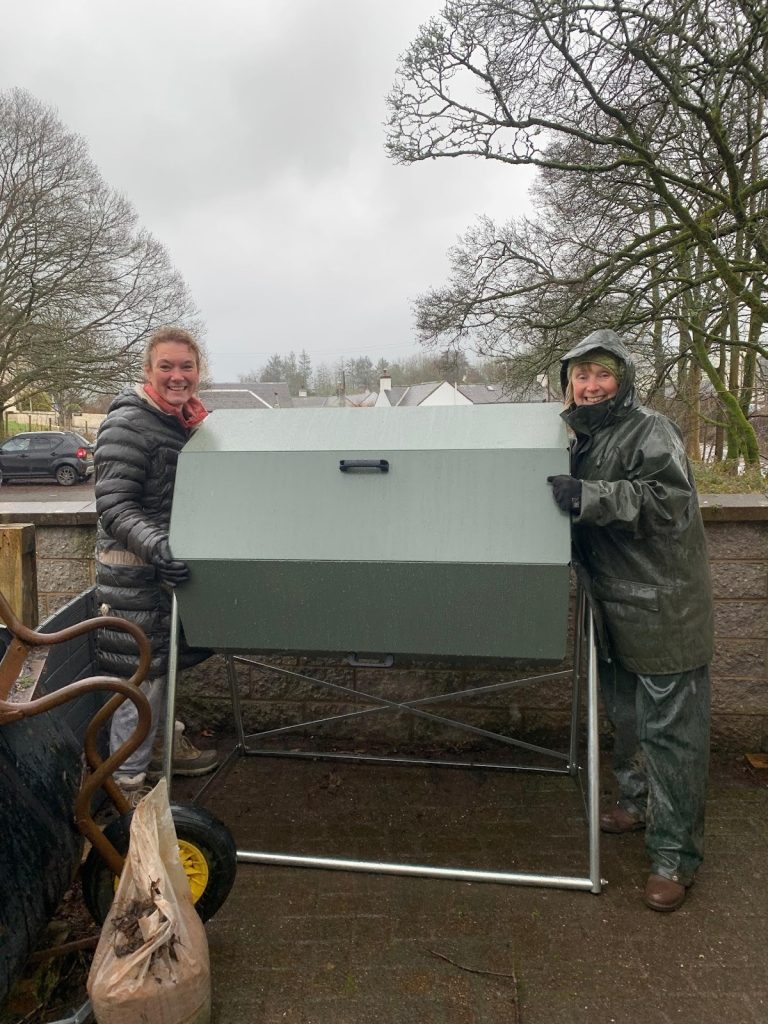
Moniaive
Led by Katie McKenzie-Wilson and a core volunteer group from Moniaive Community Garden, supported by Dawn Thomson from Propagate, the first Jora composter was built on 10th February 2026. Sixteen local people came together to clear space, construct the composter and prepare the garden for spring. Around 10 households and the local school are participating in the project so far and we will assess the capacity of the unit to transform this amount of waste over the coming months.
Gatehouse of Fleet
Led by Lusi Alderslowe from Propagate alongside a committed volunteer team, the Jora composter was assembled on 24th February. A strong team of local people assembled, pruned trees, replaced old rotten planters and generally gave the Community Centre outdoor area a bit of love. We enjoyed a visit from Senga Greenwood from the Climate Hub who loved seeing the compost outside her old primary school (as well as photos of her when she studied there!). Lots of passers-by offered their support for the project, and new connections were made. The project is already linked with the local school, starting in March with an assembly and then weekly food waste collections, alongside collections from nearby shops and homes.
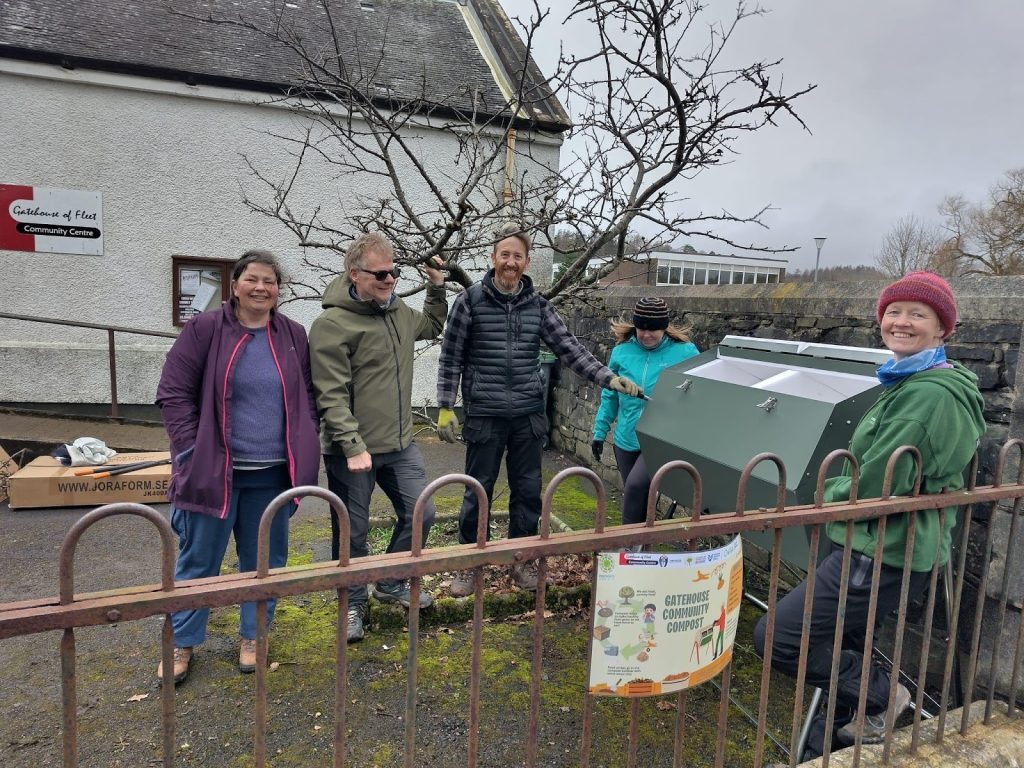
composter and sign at Gatehouse Community
Centre.
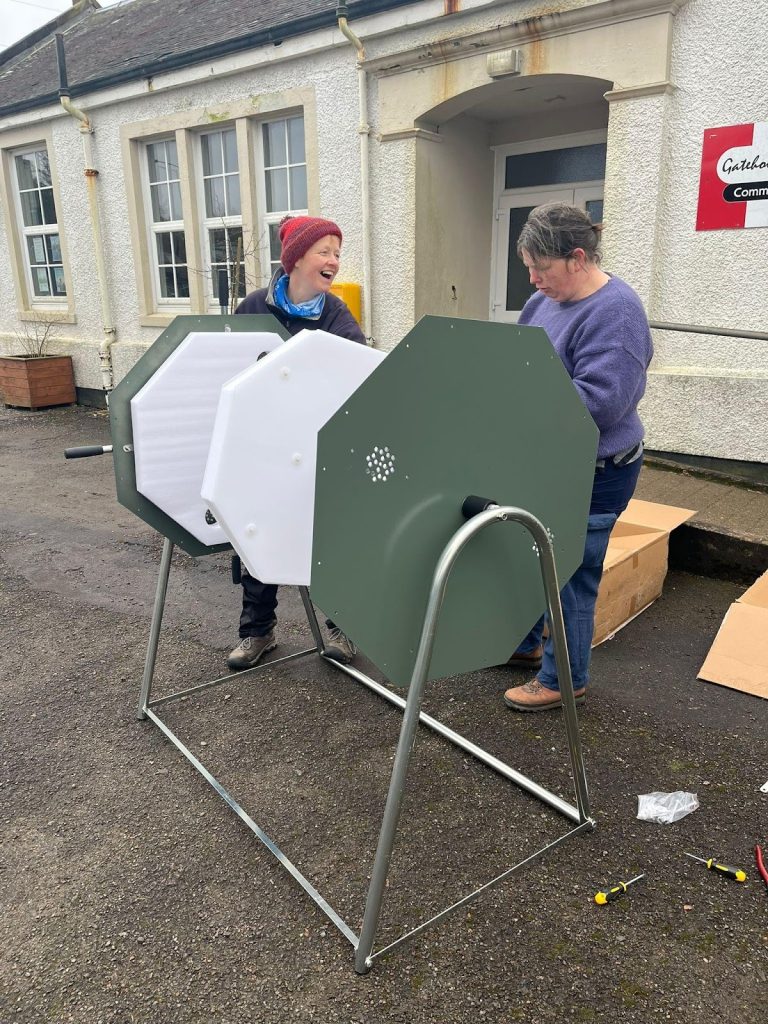
with local volunteer
Rosie during the assembly.
Whithorn
In Whithorn, Lucy Smithies from Propagate is working with South Machars Community Centre. Their build day on 21st February marked the beginning of what promises to be a strong community-led initiative.
A small team of enthusiastic volunteers came together to get the Jora built in a couple of hours before the rain came down, and then enjoyed some soup, hot drinks and chat in the centre afterwards.
The next steps are to position the composter in its final place on top of flagstones, construct a shelter over it and get the maturation bay installed.
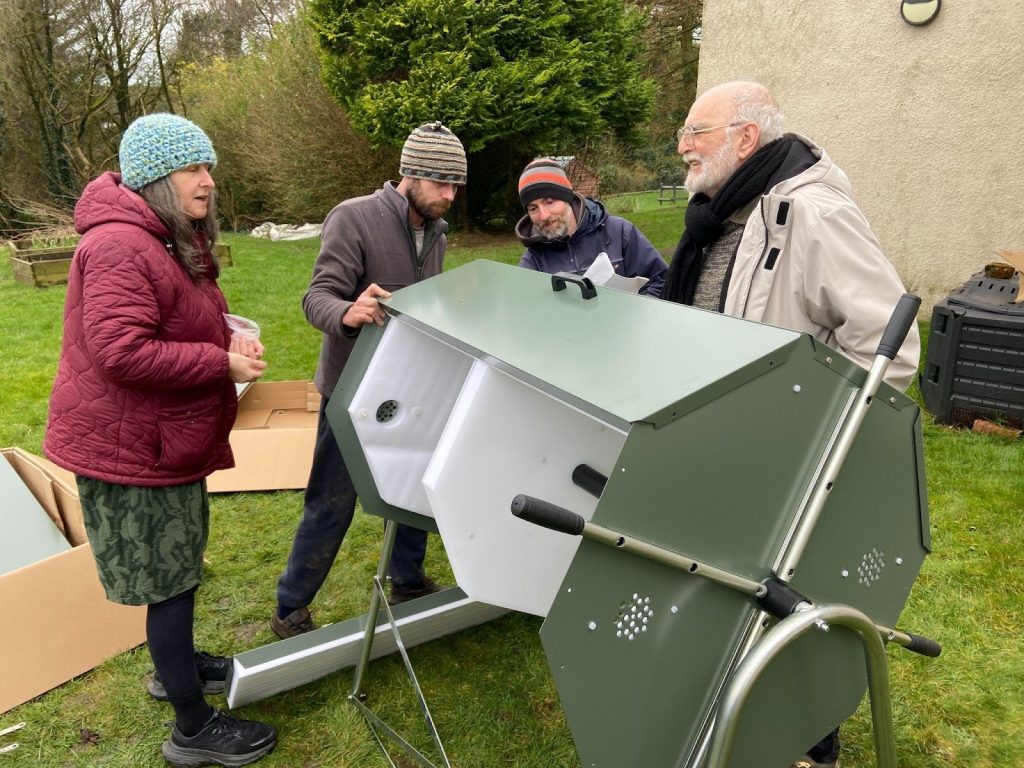
in Whithorn.
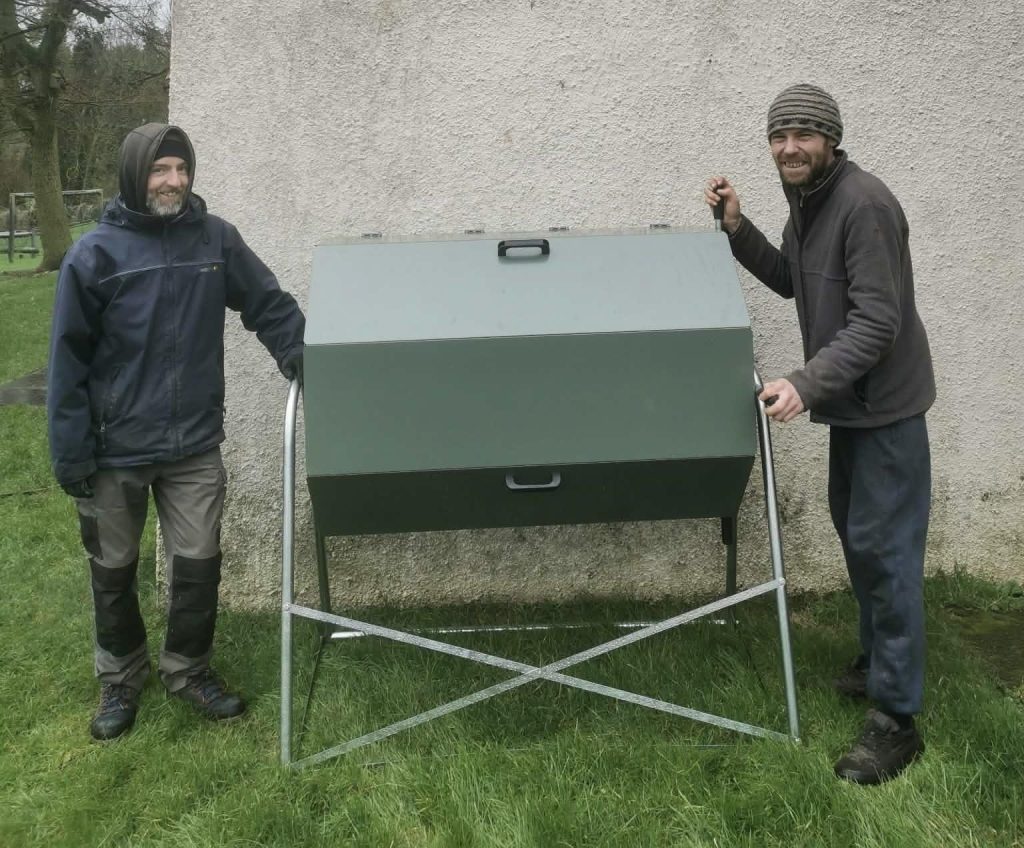
volunteer Alwyn with the finished composter
A Dumfries & Galloway Composter
In the UK, the most common community composter is the Swedish-made Jora system. Alongside this, Propagate have been collaborating with local engineer and sustainability consultant, Niki Inglis, to develop a locally made alternative. The Propagate compost team have been involved in the process throughout, from the initial concept designs through to testing the early prototype build during a visit to Niki’s workshop. Their insights have helped to shape the final design.
Using sustainably harvested timber from Carsphairn Community Woodland, recycled containers, and sheep’s wool insulation, this bespoke composter has a modular design which is adaptable, low-impact and locally sourced.
Over the coming months, we will monitor performance and compare outputs between the two systems. The findings will inform future designs and help expand community composting across the region.
What Happens After the Build Days?
The build days are just the beginning.
Each site will:
- Train volunteers
- Establish volunteer rotas
- Establish regular food waste systems
- Monitor inputs, temperatures and compost quality
- Use finished compost to improve local growing spaces
This pilot phase will generate practical learning about what works – socially, technically and logistically.
Why Community Composting Matters
Community composting delivers multiple benefits:
- Reduces methane emissions from landfill
- Builds soil health and stores carbon
- Empowers local people to take positive, permaculture actions
- Improves local food-growing capacity
- Reduces waste (including buying compost made afar and transported in plastic bags)
- Strengthens local resilience
- Creates volunteering and learning opportunities
- Engages schools and young people
- Builds relationships between growers, businesses and residents
- Keeps nutrients circulating locally
Lusi Alderslowe from Propagate says:
“Community composting is a wonderful, practical climate solution, which we can easily implement in our communities. It builds soil to help us grow food, while strengthening community connections and offering positive, hands-on responses to global challenges. It’s permaculture in action.”
What Will Happen With the Findings?
This is a pilot project. The learning gathered – from composter performance to volunteer engagement – will inform:
- Improvements to the Dumfries & Galloway composter design
- Guidance for other communities
- A potential Phase 2 expansion across the region
Our ambition is to create a model that can be replicated widely, using local skills and materials.
Tips for Other Communities
If you’re considering starting community composting, here are some early lessons:
- Start with a committed core team.
- Work with your local community, addressing any concerns as they arise and working with their needs
- Choose an accessible, community site.
- Plan for ongoing management – not just the build.
- Secure a reliable source of carbon material (e.g. woodchip).
- Keep good records – data helps secure future funding.
- Engage schools and local businesses early.
- Celebrate milestones – composting should be joyful (if it isn’t fun, it isn’t sustainable!)
Get Involved
If you live near one of the pilot communities and would like to contribute food waste or join a volunteer rota, please get in touch.
If you live elsewhere in Dumfries & Galloway and are interested in being involved in Phase two, email hello@propagate.org.uk to join the waiting list.