Carol Anne is the Project coordinator for the Kilmallie Community Fridge and Garden, located adjoining their community garden, around the side of the Kilmallie Community Centre in Corpach near Fort William. The project has been in operation over 18 months (starting in April 2024). This case study can be read in conjunction with the spotlight available through the Highland Community Waste Partnership legacy website.
What were the reasons for you to want to start your site?
As the coordinator for the Kilmallie Community Fridge and Garden, we had already expanded from being purely a Community Fridge (saving food from going to waste) to developing a community garden.
We had always thought a community composting site was a great idea and would tie in well with our project, but were steered away from it by worries about SEPA registration.
Our Story
A community growing area needs good compost to help enrich the soils, and being able to produce our own from food scraps fitted so well with both our food waste reduction project and our community garden.
During 2024, we were approached by Lesley Hawkins (from Lochaber Environmental Group) and Brenna Anderson (from Highland Good Food Partnership) who were the Project Officers for the Highland Community Waste Partnership (HCWP)*, who were keen to start some pilot community composting sites, so we jumped at the chance!
Challenges and Results
Part of the challenge for us had been the apparent complexity of the SEPA exemptions. Lesley and Brenna completed the relevant SEPA exemption paperwork, and identified the correct size compost bins to comply with SEPA regulations through the HCWP funds.
We discussed what we thought would be the best solution for us, and we determined to only compost vegetable and fruit scraps and to not include any animal derivatives.
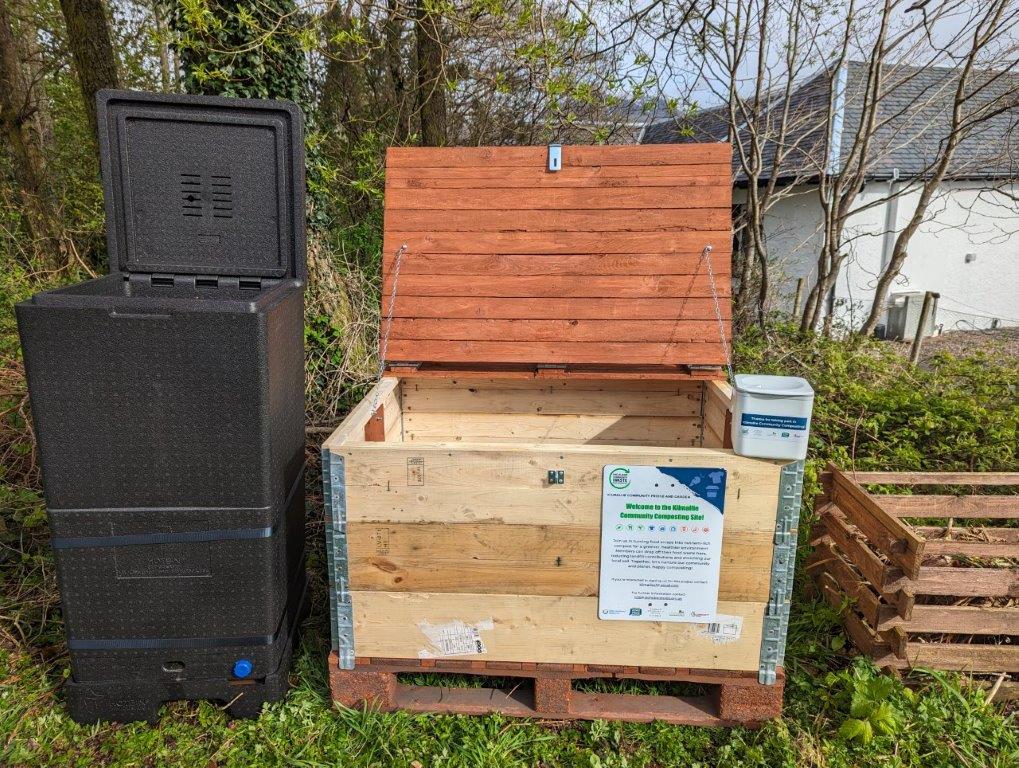
We wanted to see if we could use hot composting to decrease the time taken to produce compost, and also to help kill any seeds that might be part of the input. We were provided with a 200L Hotbin and plinth, and a specially made cold compost bin that could be locked to stop people putting unwanted items into the compost. We transfer the compost out of the hot bin into the cold compost bin to finish off, once the hotbin gets full.
Brenna was also able to provide us with home composting caddies so that each participant had the same caddy, so that the weight remains the same for our record keeping.
We used posters and sign up sheets that were developed to get interest and sign up our initial volunteers for the pilot project. These volunteers drop off their home food waste (kitchen waste) every week. They turn the compost that is transferred into the cold compost bin, to help aerate it and finish it off. We developed a WhatsApp group that everyone has access to and a google Form to complete each time they drop off a caddy full. This records the date and the weight of the kitchen scraps they are bringing to compost.
Our Biggest Challenges.
Volunteers.
Getting a reasonable number of volunteers was a problem to start with – we only had 4 or 5 to start. However, we have gradually worked up to 10 which works well with the space we have. It was important to get started, and not wait to get the numbers we hoped we would, but we continued to promote the site through our community newsletter and posters/social media.
Getting the hotbin hot and other thoughts.
Getting the hot bin up to temperature was also quite difficult. We struggled with this at first, as it is hard to get it to temperature when it is less full. When it did fill and had to be emptied, it wasn’t quite at a finished state. We therefore transferred this into the cold compost bin to finish it with regular turning.
We have also found that it can be quite awkward to empty the hotbin, and would consider the option of an insulated rotating compost bin in the future. This would allow the bin to be off the floor, and get a wheelbarrow underneath it when the hatch is opened. It would also allow us to determine if turning and aerating the mixture would enable it to get hotter more quickly.
Our compost was too wet.
When we were first starting out, our compost was wet. We were lucky to get a delivery of woodchips, and so had each of our volunteers add a handful of woodchips each time they dropped off their caddy-full.
A small egg issue.
We have had to remind people that we can’t put egg-shells into our compost because they are an animal derivative. This was easily fixed by having discussions with the composting and fridge groups to remind them what we can compost as part of our scheme.
To lock or not to lock
Initially we had designed the system so that we could lock the bins, but as the scheme is located out of the way we decided against locking them unless we came across issues. We had one occasion when someone was putting their un-composted scraps into the cold compost bin and not starting the process in the hot-bin. We traced this to being a member of the wider Kilmallie Community Fridge & Garden project and were able to resolve the issue.
It has been great that, except for this issue, the bins have not been mis-used and people haven’t been filling them with inappropriate waste.
Results.
What has community composting done for you / the community?
Since starting the project, we have composted 789Kg of kitchen waste!
We have recently got a compost that we can use, and so we have sown some winter crops. As we have a team of people who take turns in turning the compost, the co-ordinator hadn’t looked in the cold be for quite a while, and was really pleased with the quality of the compost when they used it recently. The roto for turning the compost has made such a difference!
The compost that is ready will be great to use for the next growing season! Some of our volunteers had not composted previously, or were nervous about composting, and our community composting site has given them the confidence to compost for themselves at home too.
One unexpected consequence of the site has been a runover into the gardening and fridge groups which has meant we have gained new volunteers through to the wider project.
We have also made links with other groups and had conversations to help them set-up on their own.
We would really like to expand our site and continue to educate people about the benefits of compost and of composting.
“Seeing community bonds forming between volunteers really does make me smile no end!”